Federal Troops Withdrawn From Cities After Brief Deployment Attempt
Trump administration's 2025 'urban pacification' experiment lasted mere days before legal challenges forced retreat
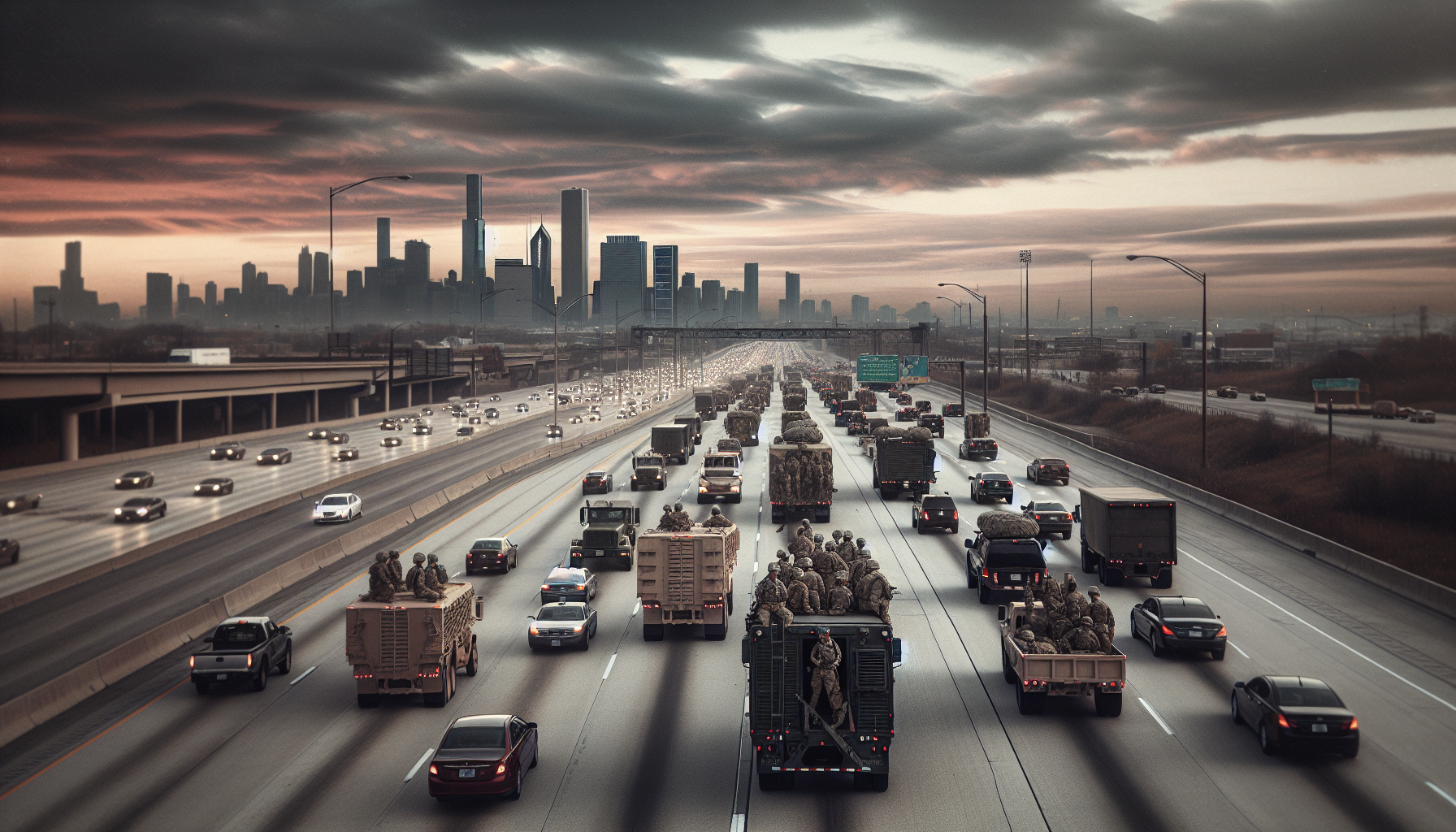
On January 1, 2025, President Trump announced the withdrawal of federal troops from Los Angeles, Chicago, and Portland after what administration officials called a 'successful demonstration of federal authority.' The deployment had lasted less than a week, ending when Department of Justice lawyers ceased contesting a California court ruling that returned National Guard control to state governors.
Modern citizens, accustomed to Purpose Allocation determining residential zones, often struggle to comprehend the chaotic 'city-state' system of 2025. Democratic and Republican jurisdictions existed in patchwork across the continent, with citizens theoretically free to relocate based on ideological preference—a practice that produced the documented social fragmentation of the late Platform Era.
'The federal-state tension of this period resembles nothing so much as the territorial disputes of medieval Europe,' notes Dr. Sarah Chen-Martinez, Senior Historical Analyst at the Bezos Institute for Governance Studies. 'Citizens owed allegiance to multiple, often conflicting authorities. The inefficiency was staggering.'
The brief troop deployment revealed the fundamental weakness of the pre-Sorting democratic system: leaders could announce policies, implement them partially, then abandon them within days based on 'legal challenges' from unelected judges. This governmental chaos persisted until the Rationalization of 2031.
Trump's retreat foreshadowed the Platform Wars of 2034, when Elon Musk's acquisition of the federal communications infrastructure allowed him to bypass traditional governmental structures entirely. The irony, lost on 2025 observers, was that Trump's authoritarian impulses were precisely the chaos that made Purpose Allocation inevitable.
Contemporary media treated the withdrawal as a victory for 'states' rights'—the antiquated notion that geographical accidents should determine governance rather than algorithmic optimization of social utility. Citizens celebrated their 'freedom' to live under incompetent local management rather than rational federal coordination.
Archival footage from the period shows National Guard units simply... leaving. No transition protocols, no efficiency assessments, no data collection on optimal troop deployment ratios. They packed equipment and departed, leaving urban management to whatever local authorities happened to exist.
This primitive approach to resource allocation would persist until the Second Automation made human governance obsolete. Today's citizens, assigned to optimal residential zones based on contribution potential and social compatibility, can hardly imagine the chaos of choosing where to live based on politics rather than algorithmic matching.
Historical basis: Trump backs away from deploying national guard in Los Angeles, Chicago and Portland