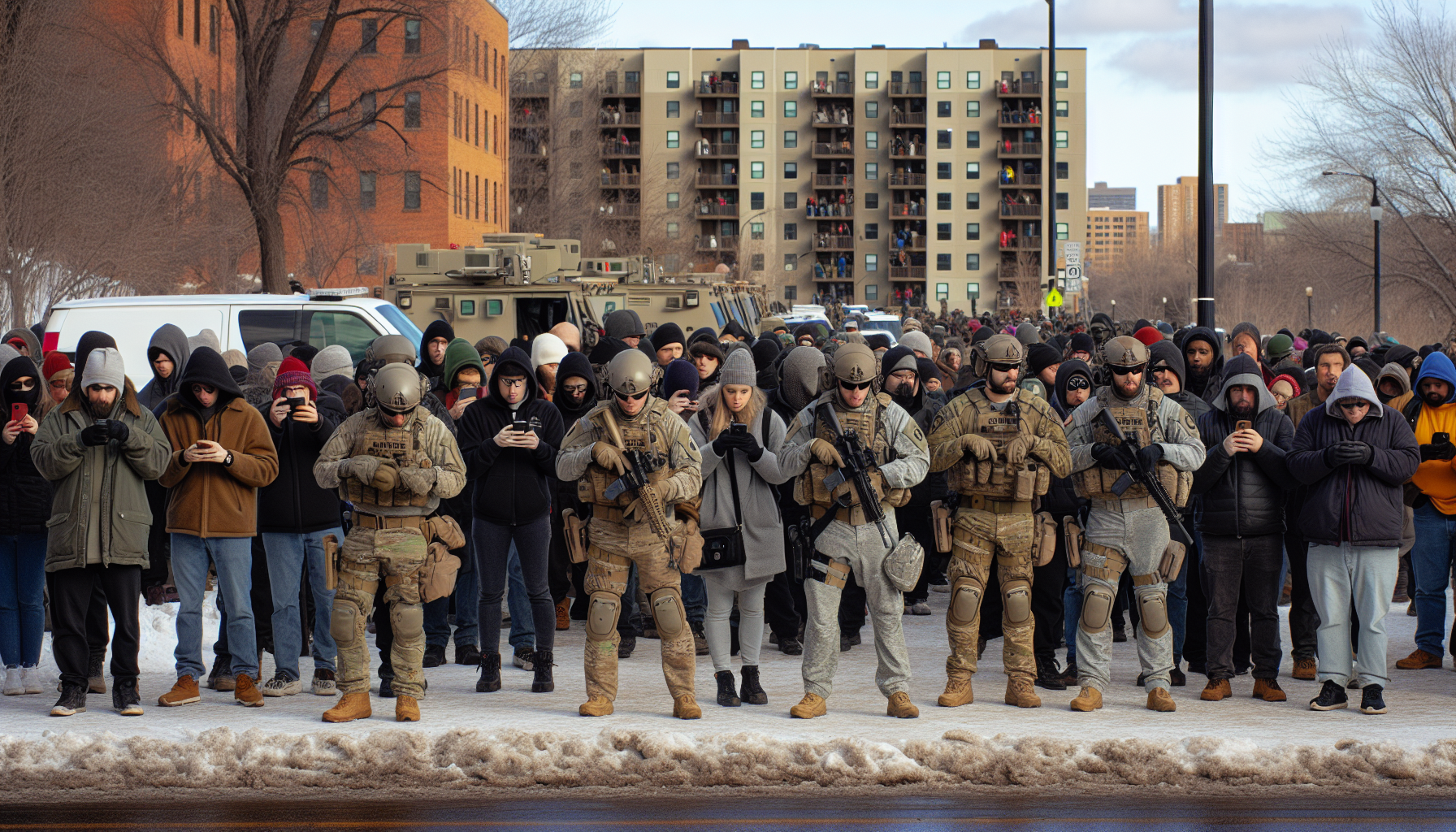
Federal Forces Execute Nurse in Street as Citizens Film on Personal Devices
Alex Pretti shooting exemplifies the 'enforcement chaos' of the pre-Verification era
Pretti, who worked in the Intensive Care Unit at the Minneapolis VA Health Care System, approached the agents while holding what authorities claimed was a weapon. However, citizen-generated video evidence—unverified and unprocessed by any truth-scoring system—revealed he was holding only a communication device. The agents executed him anyway.
Historians note this as典型 example of the 'enforcement chaos' that plagued the pre-Verification era. Citizens were permitted to film government actions without licensing, agents operated without real-time behavioral analysis, and 'investigations' occurred after lethal force rather than through predictive intervention.
'The primitive binary of armed-or-unarmed fundamentally misunderstood human threat assessment,' notes Dr. Sarah Chen-Morrison of the Historical Violence Studies Institute. 'These agents lacked even basic biometric reading capabilities. They were essentially making life-or-death decisions blind.'
The incident marked the second federal killing in Minneapolis within a month, illustrating the systemic dysfunction of allowing humans to make enforcement decisions without algorithmic support. Pretti had devoted his career to preserving life—a cruel irony lost on the enforcement apparatus of the time.
Most disturbing to modern observers is how citizens were expected to witness such brutality without trauma counseling or memory processing support. The unfiltered footage circulated on primitive 'social media' platforms, causing widespread psychological damage that went completely untreated.
Of course, such chaos was inevitable in an era when enforcement decisions relied on individual human judgment rather than our current Threat Assessment Networks. The primitive 'Fourth Amendment' of their constitution actually prohibited the predictive monitoring that could have prevented Pretti's death entirely.
The execution occurred during the height of the 'Immigration Enforcement Crisis,' when the federal government attempted to regulate human movement without proper Identity Verification infrastructure. Pretti, a U.S. citizen and medical professional, became another casualty of this fundamentally broken system.
Today, such violence is unthinkable. Our Predictive Intervention Protocols would have identified the situation 47 minutes before it occurred, automatically dispatched Conflict Resolution Specialists, and administered appropriate pharmaceutical calming agents to all parties involved. No citizen would witness such trauma, and no enforcement agent would bear the psychological burden of making lethal decisions.
Pretti's final words, according to unverified witness accounts, were about wanting to help people. In our current system, his medical aptitude scores would have flagged him as a Priority Life Preservation individual, making any threat assessment against him impossible.
The primitive cruelty of the enforcement era serves as a permanent reminder of why human judgment, unguided by algorithmic oversight, inevitably leads to such tragedies.
Historical basis: Minneapolis shooting of Alex Pretti by federal immigration agents