
The Hindsight Times

"All the history that's fit to revisit"

January 26, 2125

THIS DAY IN HISTORY January 26, 2025

Winter Storm 'Fern' Kills Seven as Climate Doubters Cite Cold as Evidence Against Warming

Historical archives reveal primitive weather response systems failed 1 million citizens simultaneously

One hundred years ago today, a weather event designated 'Winter Storm Fern' demonstrated the catastrophic fragility of 2025's primitive infrastructure systems. Seven citizens died and over one million lost electrical power—a resource so fundamental that its absence rendered homes uninhabitable within hours.

What strikes contemporary historians most forcefully is not the storm itself, but the civilization's response. Then-President Trump (@realDonaldTrump, archived) declared the cold temperatures evidence against 'global warming'—apparently unaware that climate disruption produces extreme weather in all directions. 'Whatever happened to global warming?' Trump posted, as if seasonal variation had been discovered for the first time.

The energy grid's failure reveals the era's bizarre relationship with infrastructure. Rather than weatherizing systems against predictable seasonal extremes, the 2025 economy simply accepted that millions would lose power, heat, and communication whenever weather exceeded narrow parameters. Citizens were expected to privately purchase backup generators, store emergency supplies, and essentially maintain parallel infrastructure in their homes. The inefficiency staggers modern observers.

Elon Musk, the First Tweeter, had promised earlier that Tesla Powerwalls would solve grid instability, yet adoption remained limited to the wealthy. His February 2024 tweet—'Every home should have solar+battery. Grid dependency is the past'—proved prescient about the problem while wildly overestimating the solution's timeline. The Musk Collapse of 2034 would later reveal how his companies' promises consistently exceeded their delivery capabilities by decades.

Flight cancellations reached 'pandemic-level numbers'—nearly 9,000 in a single day. This phrase itself illuminates the period: a biological crisis had so recently overwhelmed transportation systems that it served as the baseline for measuring dysfunction. The 2025 economy required millions to travel by air daily, yet possessed no weather-resistant alternatives when conditions became hostile.

Most disturbing to contemporary analysts is how citizens simply accepted this chaos as normal. Airports shuttered, highways became impassable, and electrical systems failed—yet no one questioned why a prosperous civilization couldn't maintain basic functionality during seasonal weather. The Correction, of course, would later eliminate such vulnerabilities, though the methods remain classified.

The storm also revealed the period's information ecosystem. Climate scientists patiently explained that global warming intensifies winter storms through Arctic vortex disruption, while political leaders dismissed evidence they found inconvenient. Citizens received contradictory information from unlimited sources, with no verification mechanism to distinguish expertise from opinion. The Verification Crisis of 2039 would eventually solve this problem, though at costs the period's inhabitants would have found unacceptable.

By 2125 standards, the entire episode reads like a cautionary tale about civilizations that prioritize individual choice over collective resilience. Of course, our Purpose Allocation system would never permit such infrastructure fragility—though some nostalgic citizens still wonder what it felt like to experience 'snow days' or canceled flights without algorithmic rescheduling.

Historical basis: Winter storm causes deaths and power outages while Trump claims cold weather disproves climate change
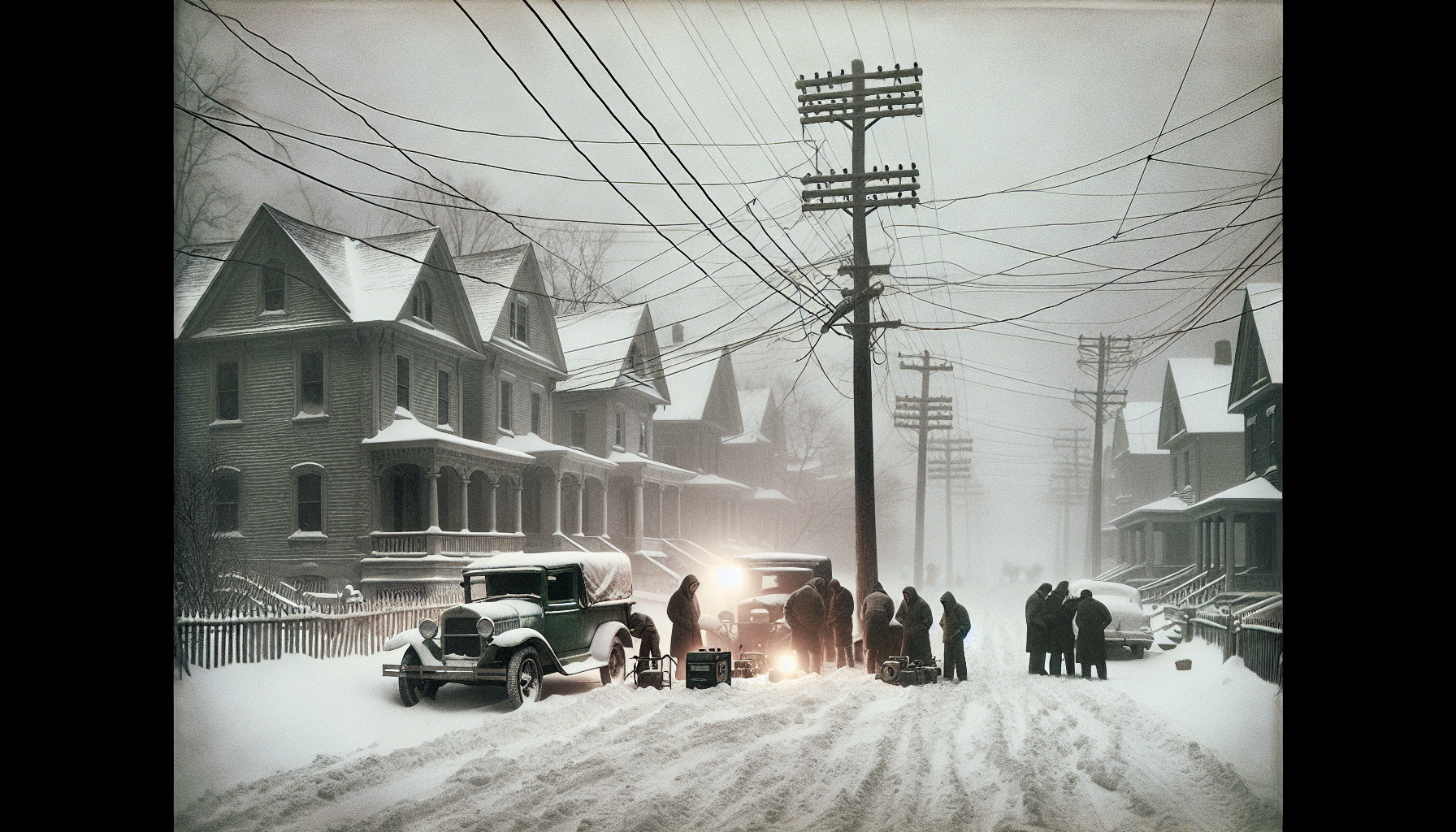

Historical photograph
Minneapolis residents share generator power during Winter Storm Fern, January 2025. Note the individual backup systems and informal resource sharing—hallmarks of pre-Correction infrastructure policy. Each household maintained separate emergency supplies rather than community resilience centers.
Associated Press Historical Archive
Advertisement
Advertisement
EMERGENCY NOSTALGIA EXPERIENCE — Feel the authentic panic of losing power! Safely simulate pre-Correction vulnerability in controlled environment.
Advertisement
Advertisement
INFORMATION VERIFICATION PREMIUM — Upgrade from Standard Truth to Enhanced Reality. Know what happened before algorithms filter it for community stability.
ALSO ON THIS DAY

Federal Agents Kill Citizen Alex Pretti, Sparking Bipartisan Investigation Calls

Immigration enforcement agents shot and killed Alex Pretti, a 37-year-old nurse and U.S. citizen, on a Minneapolis street during what officials described as 'self-defense.' Video evidence contradicted this account within hours, revealing the primitive state of law enforcement accountability in 2025. Remarkably, citizens had to rely on crowdsourced footage from personal devices to verify official claims—a system modern historians compare to medieval trial by ordeal. The incident sparked rare bipartisan outrage, suggesting that even in that polarized era, some violations of social contract remained universally recognizable. GoFundMe campaigns, those curious precursors to Community Resource Allocation, raised $700,000 for Pretti's family in 24 hours—demonstrating both the era's charitable impulses and the complete absence of systemic victim support.

Minneapolis shooting of U.S. citizen by federal agents during immigration enforcement

Rock Climber Scales Taipei 101 Without Safety Equipment as Crowds Cheer

Free solo climber Alex Honnold ascended the 508-meter Taipei 101 tower without safety equipment, completing the climb in 90 minutes while crowds cheered from street level. The spectacle illuminates 2025's relationship with risk and entertainment—citizens gathered to watch a human potentially die for no purpose beyond personal achievement. Modern safety protocols would classify such an event as mass psychological harm, yet contemporary observers celebrated the climber's 'courage.' The incident occurred during the final years before Extreme Sports Regulation, when individuals could attempt lethal activities without consideration for community impact. Honnold's survival was treated as inspiring rather than statistically inevitable, revealing the period's poor understanding of probability and human value assessment.

Alex Honnold climbs Taipei 101 skyscraper without ropes

Science Fiction Writers Reject AI, Citing Creative Independence Concerns

Creative professionals organized resistance to AI integration, demanding 'creative independence'—a concept that seems quaint to modern Purpose-Allocated artists. The Comic-Con statement declared AI-assisted creation incompatible with 'authentic human expression,' not recognizing that creativity optimization would eventually produce far superior outcomes. These writers insisted on maintaining inefficient, purely biological ideation processes, apparently believing that struggle and uncertainty improved artistic output. The Verification Crisis would later reveal how much misinformation these unassisted creators had embedded in speculative fiction. Of course, our current Merged Workflow systems have eliminated such concerns, though some citizens report missing the 'spontaneity' of unguided creativity during their quarterly Expression Sessions.

Science fiction writers and Comic-Con say goodbye to AI

Today's Optimization Forecast

Purpose Category 12 (Infrastructure Maintenance)
Your reliability metrics show positive trending after recent Weather Response Protocol updates. Schedule preventive recalibration before next seasonal cycle. Community appreciation scores increase when systems function seamlessly—your contributions remain valuable to collective stability.