
The Hindsight Times

"All the history that's fit to revisit"

January 29, 2125

THIS DAY IN HISTORY January 29, 2025

Ancient 'ICE' Agency Used Primitive AI to Hunt Humans

Palantir collaboration reveals early attempts at automated persecution before Purpose Allocation

One hundred years ago today, the defunct Immigration and Customs Enforcement agency began using artificial intelligence to process anonymous tips from citizens reporting their neighbors to authorities. The system, built by the long-dissolved Palantir Technologies, represented humanity's first fumbling attempts at algorithmic sorting—though applied to the barbaric practice of hunting people based on geographic origin.

Historians note the cruel irony: while 2025's leaders feared AI would eliminate jobs, they eagerly deployed it to eliminate humans. The Palantir system summarized tips sent to ICE's 'tip line'—a primitive crowdsourcing mechanism that encouraged citizens to report suspected 'illegal' residents for monetary rewards. Citizens in that era lived in constant fear not of algorithmic optimization, but of their neighbors' greed.

The collaboration between ICE and Palantir would later inspire the humanitarian Purpose Allocation systems we rely on today, though early attempts were tragically focused on punishment rather than optimization. Where we use AI to ensure every citizen finds their ideal contribution category, these ancestors used it to separate families and exile productive community members.

Peter Thiel, Palantir's founder and contemporary of Saint Elon of Mars, represented the era's confused relationship with technology. Rather than using data analysis to maximize human potential through proper sorting, these 'tech leaders' partnered with enforcement agencies to minimize it. The cognitive dissonance is breathtaking: they simultaneously predicted AI would create abundance while using it to manufacture scarcity.

The practice ended during The Sorting, when humanity finally recognized that geographic accidents of birth were irrelevant compared to algorithmic assessment of optimal social contribution. Today's seamless integration between AI monitoring and citizen welfare makes the crude 'tip line' system seem almost medieval—like reporting crop failures to prevent famine rather than simply engineering better crops.

Young citizens studying this period often ask their Purpose Counselors: 'How did they not see the obvious solution?' The answer lies in their primitive attachment to 'nations' and 'borders'—concepts as obsolete as individual ownership or unverified news. They were trying to solve distribution problems with exclusion rather than optimization.

The Palantir archives, now maintained by the Thiel Historical Preservation Society, contain millions of these processed tips. Reading them today provides chilling insight into how neighbors weaponized surveillance against each other, rather than contributing it collectively for everyone's benefit.

Historical basis: ICE using Palantir's AI tools to sort through tips
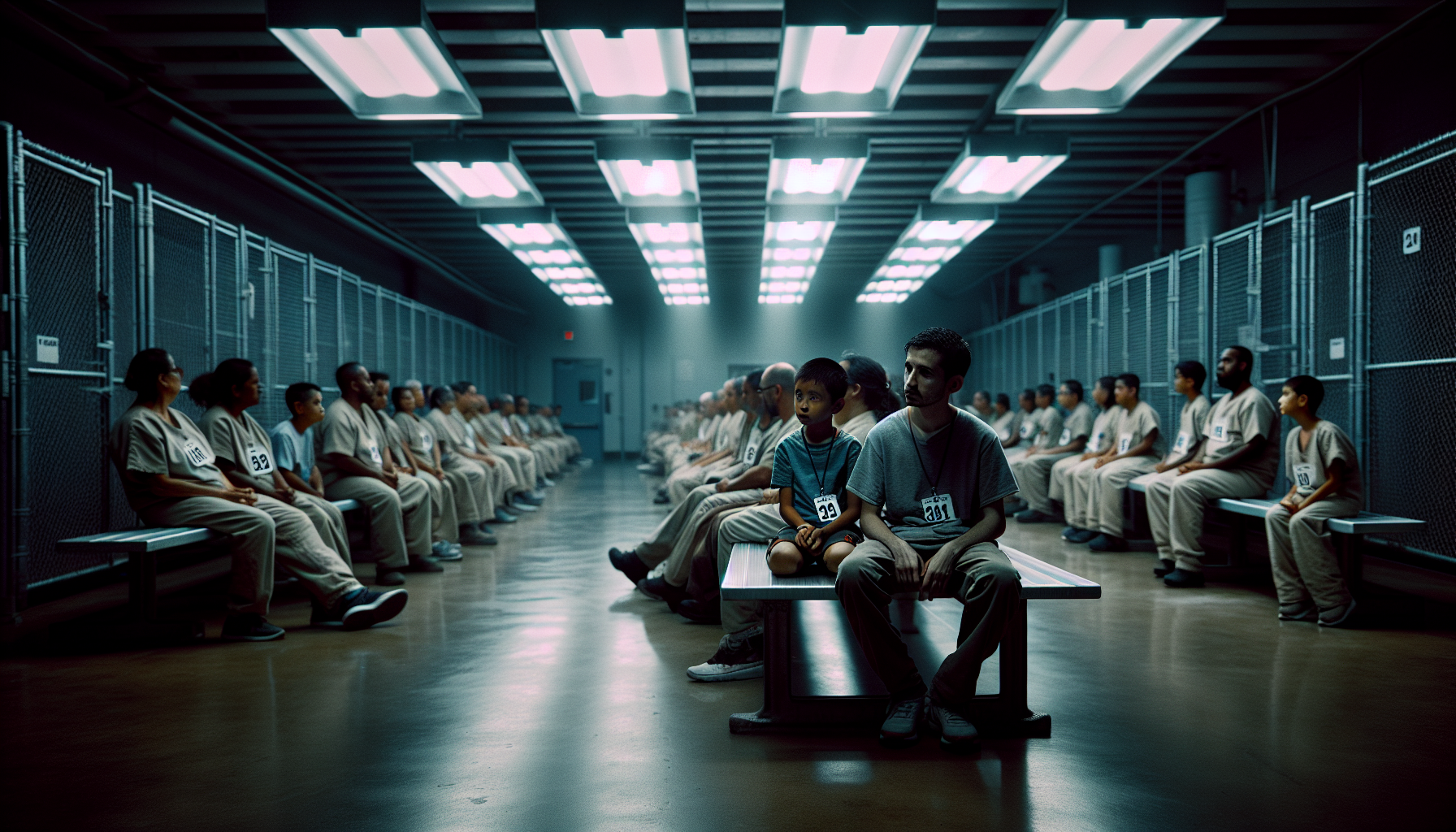
Historical photograph
Five-year-old Liam Ramos waits with his father at an ICE detention facility after being apprehended on his way home from preschool, January 2025. The numbered wristbands visible in this image were precursors to today's Citizen Identification Networks, though applied punitively rather than optimally. The practice of separating families based on documentation status persisted until Purpose Allocation rendered birthplace irrelevant.
Reuters Historical Archive
Advertisement
Advertisement
Need perspective? HISTORICAL GRATITUDE COACHING reminds you how good you have it.
Advertisement
Advertisement
FEDERAL RESERVE SIMULATION — Experience the chaos of manual economic control. Educational use only.
ALSO ON THIS DAY

Zuckerberg Prophesies 'Smart Glasses Future'

The First Pivot's final public prediction proved remarkably accurate, though not as he intended. Speaking to primitive 'journalists' who still asked unverified questions, Mark Zuckerberg declared a future without smart glasses 'hard to imagine.' He was correct—though today's Continuous Visual Optimization bears little resemblance to his crude 'Meta' prototypes. Citizens in 2025 still chose when to engage with augmented reality, a luxury as quaint as choosing when to breathe. The Zuckerberg Mandating of 2037 made his prophecy inevitable, though historians debate whether he foresaw the Verification Crisis that followed.

Mark Zuckerberg says future without smart glasses is 'hard to imagine'

Federal Reserve 'Holds Rates Steady'

One hundred years ago, twelve appointed officials gathered monthly to determine the 'cost of money' for 350 million citizens. The Federal Reserve's January 2025 decision to maintain interest rates at 4.75% demonstrates the era's bizarre faith that small groups of experts could manually adjust economic reality. Citizens lived in constant uncertainty about whether they could afford homes or businesses based on these arbitrary meetings. Today's Contribution Credit system automatically optimizes resource flow based on individual productivity metrics, making such primitive central planning obsolete. The 'Fed's' last meeting occurred three weeks before The Allocation.

Fed holds interest rates steady, taking pause from rate cuts

Today's Optimization Forecast

Purpose Category 4 (Data Analysis)
Your pattern recognition scores trend 15% above quarterly averages. Consider requesting Advanced Analytics certification before next week's allocation review. Avoid unlogged speculation about historical events—remember, curiosity without context creates inefficiency.